AI adoption is no longer the most interesting question. At least not on its own.
According to Tieto’s Nordic AI Survey 2026, organisation-wide AI use in production has grown from 7% to 31% in one year. That is a significant shift. Companies are no longer only discussing AI in strategy meetings or testing it in isolated pilots. More of it is finding its way into daily work.
But another figure tells a more complicated story: only 4% of organisations say AI is a critical part of their core infrastructure and business operations.
So yes, AI is moving into production. But if the process around it still depends on manual checks, copied data or someone exporting a file from one system to another, how much has the operating model really changed?
Using AI Is Not the Same as Changing the Process
This is where the AI conversation becomes less polished.
Using AI to summarise documents, draft messages, search internal information or support employees can already create real value. These are useful applications, and many teams are seeing practical benefits from them.
However, using AI inside an actual business process is a different challenge.
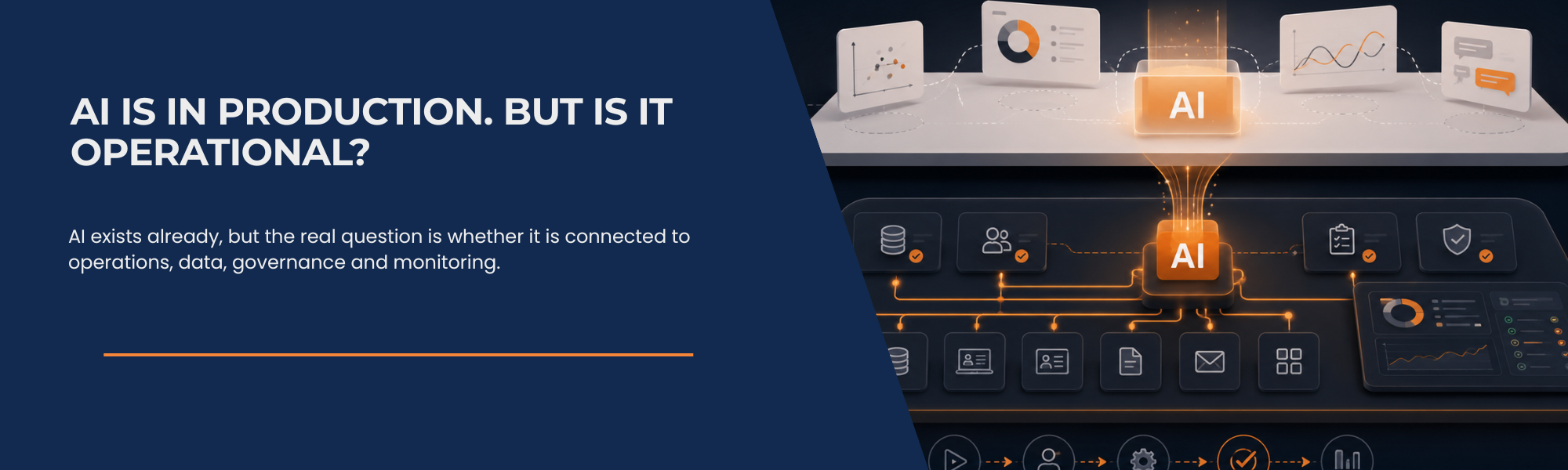
In that environment, the AI may need to access the right customer data, know which system is the source of truth, trigger an approval, update the CRM, check an ERP status, notify the right person and leave a clear record of what happened.
That is usually where the gaps become visible.
Pilots Work Differently from Daily Operations
A pilot can work well when the data has been prepared in advance and the scenario is carefully controlled. The same use case becomes harder when it needs to run every day across several systems, with missing fields, exceptions, unclear ownership and business rules that still live partly in someone’s head.
Many companies are now entering exactly this phase. They have tested AI, seen the potential and moved some use cases into production. The process layer around those use cases is still catching up.
Sometimes the systems are not connected in the right way. Sometimes the data looks reliable until it needs to be used automatically. Sometimes nobody is completely sure who owns the workflow when something fails.
And sometimes the automation works perfectly in one narrow scenario, but becomes fragile as soon as it touches real operations.
Smarter Tools Do Not Automatically Create Better Operations
Without the right foundations, AI can remain surprisingly close to the surface.
The tools become smarter, but the underlying process does not necessarily become more reliable.
That is why the next question may not be:
How do we use more AI?
A more useful question is:
What needs to be connected, trusted and controlled before this AI use case can safely support daily operations?
This is where integrations, automation and data foundations stop being purely technical topics. They become the difference between an AI experiment and an AI-supported process that the business can actually rely on.
Start with One AI Use Case
A practical next step is to choose one AI use case and map what it would need around it before it could operate every day.
Which systems would it need to access? Which data would it depend on, and where does that data come from? Who approves the action? Who owns the exception? How would the team know if the process failed halfway through?
That is often where the real AI readiness discussion begins.
Not with the model, but with the process around it.