Generative AI, predictive AI, agentic AI…
How do you know which one to use and when? And when is good ol’ automation still enough?
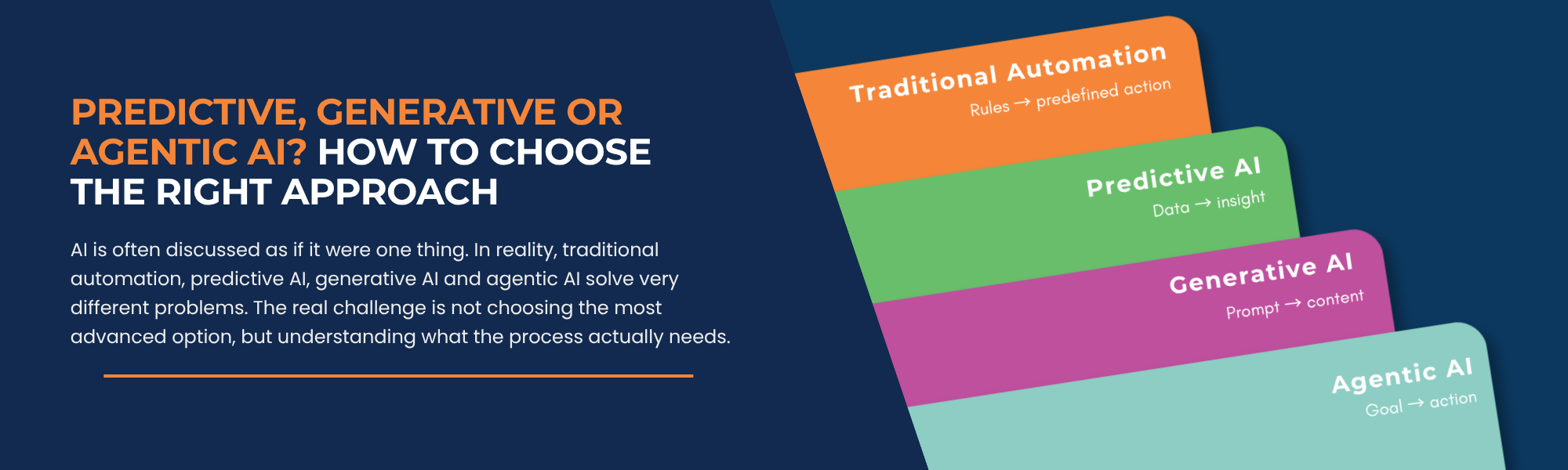
The terminology can make AI sound more complicated than it needs to be. Different technologies are often discussed as competing alternatives, even though they solve different parts of a process.
The better question is not:
Which AI is the most advanced?
It is:
What does the process actually need to do?
Let’s walk through the differences using one familiar business process: invoice handling.
Start with the process, not the technology
Choosing technology based on what is currently trending is an easy way to make a simple process unnecessarily complicated.
Some tasks require a prediction. Others require new content, a predefined action or a system that can work towards a goal across several steps.
In many cases, the best result comes from combining different technologies as building blocks rather than trying to make one tool handle the entire process.
Before looking at the different approaches, there is one important distinction to make.
When traditional automation is enough
Traditional automation works well when the process follows clear and repeatable rules.
An invoice arrives. The system checks whether the required fields are present, matches the supplier, sends the invoice to the correct approval workflow and updates the ERP after approval.
The rules are known in advance. The same conditions should lead to the same predefined action.
There is no uncertainty to interpret and no decision to improvise.
In this situation, AI may add unnecessary complexity. Reliable automation is often the better choice because it is predictable, controlled and easier to maintain.
Good ol’ automation is not outdated. It remains the foundation of many business-critical processes.
When predictive AI is useful
Predictive AI becomes useful when the process needs to recognise patterns or estimate what is likely to happen.
In invoice processing, the question may no longer be:
Does this invoice meet our validation rules?
Instead, it may be:
Does something about this invoice look unusual?
Predictive AI can compare an invoice with historical data and identify patterns that may indicate a duplicate, an incorrect amount or another anomaly.
It does not necessarily resolve the issue. Its role is to create an insight:
This invoice may need attention.
That insight can then trigger a review, an automated workflow or another AI-supported step.
Predictive AI is a good fit when the main need is identifying risk, probability, patterns or anomalies from existing data.
What generative AI adds
Once an unusual invoice has been identified, someone still needs to understand what appears to be wrong.
This is where generative AI can help.
It can summarise the situation, explain how the invoice differs from previous ones and draft a message asking the supplier or internal approver for missing information.
The output is content:
Here is what seems unusual, and here is a possible response.
Generative AI is especially useful when people need help interpreting, summarising or communicating information.
However, creating a message is not the same as making sure the issue gets resolved. Someone or something still needs to decide what happens next, send the message and follow the case through the process.
When the process needs agentic AI
Agentic AI goes beyond generating an answer.
It works towards a defined goal and can decide which action to take next within the boundaries it has been given.
In our invoice example, the goal could be:
Resolve the invoice exception.
An AI agent could gather information from different systems, check the purchase order, identify the correct approver, request missing information and start the appropriate workflow.
If no one responds, it could follow up. When the required information arrives, it could evaluate the situation again and continue the process.
The output is not only an insight or a piece of content.
The output is progress towards a goal.
That greater autonomy also creates new requirements. The agent needs access to the right systems and data, clear permissions, reliable integrations and boundaries that define what it is allowed to do.
Without those foundations, an agent may understand the task but still be unable to complete it safely or reliably.
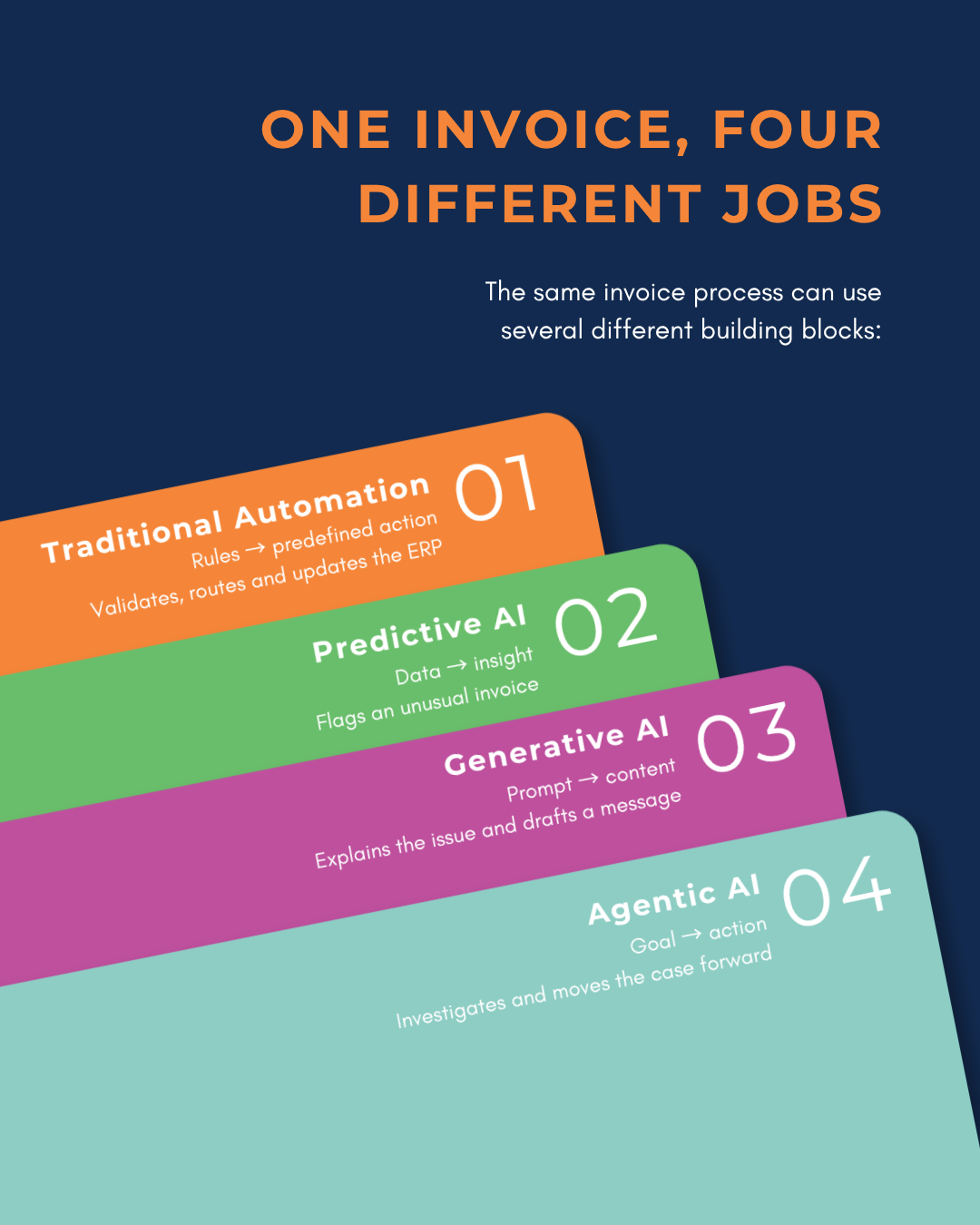
One invoice, four different jobs
The same invoice process can therefore use several different building blocks:
| Approach | Main purpose | Invoice example |
|---|---|---|
| Traditional automation | Execute predefined rules | Validate fields, route the invoice and update the ERP |
| Predictive AI | Identify patterns or risks | Flag an invoice that looks unusual |
| Generative AI | Create or explain content | Summarise the issue and draft a message |
| Agentic AI | Work towards a goal | Investigate and move the exception towards resolution |
Predictive AI spots the possible issue.
Generative AI helps explain it.
Agentic AI moves the case forward.
Traditional automation keeps the predictable parts of the process running reliably underneath it all.
The technologies do not need to compete with each other. Their value comes from using each one for the job it handles best.
How to choose the right approach
Before choosing a tool, look at the process and ask what kind of output is actually needed.
When the task follows clear and repeatable rules, use traditional automation.
When the process needs to recognise a pattern, assess a risk or estimate what may happen, predictive AI may be appropriate.
When someone needs a summary, explanation, draft or other new content, generative AI can help.
When the process has a goal that requires several decisions and actions across systems, agentic AI may be worth considering.
The answer may also be a combination.
A predictive model can identify the issue, generative AI can explain it, an agent can coordinate the resolution and traditional automation can handle the reliable system updates.
The most advanced option is not always the best one
The goal should not be to use as much AI as possible.
It should be to build a process that works.
Sometimes that requires agentic AI. Sometimes it requires several different technologies working together.
And sometimes good ol’ automation is still exactly what the process needs.
What does your process actually need: an insight, content, a predefined action or progress towards a goal?